"Before you deposit, understand the rules of the wheel. A big bonus will not save you if you choose a game with a high house edge. Treat casino play as entertainment, set strict limits, and always compare the payout terms before taking real money action." - Nisha Rao, Content Editor, Casino and Betting India.

Roulette Online Guide: Rules, Live Dealer Games and Best Ways to Play
Provider
Evolution Gaming
RTP
96.70%
Max win
35.1x

Disclaimer: 18+ only. Gambling laws vary by Indian state. Online roulette may not be legal in every jurisdiction (e.g. Telangana, Andhra Pradesh). Verify the rules in your state before playing. If you or someone you know shows signs of problem gambling, contact a licensed counsellor or helpline immediately. This article is for educational purposes; it does not constitute financial or legal advice.
Quick summary: Roulette is a negative-expectation game of chance where a ball lands in a numbered pocket on a spinning wheel. European roulette (2.70% house edge) and French roulette with La Partage (1.35%) offer the best odds. No betting strategy can override the house edge. Play demo mode to learn the interface, set a strict INR bankroll before switching to real money, and always choose licensed, single-zero tables.

What roulette is and how the game works
Roulette is a classic casino game of chance. A small ball spins around a numbered wheel, and you bet on where it will land. Simple enough on the surface, right? But the details matter more than most beginners expect.
The game was first conceptualised in the 17th century when French mathematician Blaise Pascal experimented with perpetual-motion machines. The modern casino layout emerged in 18th-century France and has remained essentially unchanged since around 1790. That longevity tells you something about the design: it works, and it keeps the house profitable.
In our early analysis of the iGaming sector in India on the Casino and Betting India platform, we noticed Indian users frequently jumping into live roulette games without tracking their bankroll. We published a strict pre-play checklist requiring users to master basic mechanics first. Players who followed the guide stopped chasing complex inside bets and shifted toward safer even-money play. The game mechanics are fully transparent, but every spin operates independently and the expected return is always negative for the player.

"A simulation of 10 million roulette spins confirms that the outcome is a purely physical or algorithmic random event; neither the player nor the dealer can influence the result after the ball is launched." - CasinoEdges, "10M Roulette Spins: Do Betting Systems Work?" (2024).
The roulette wheel, table and betting layout
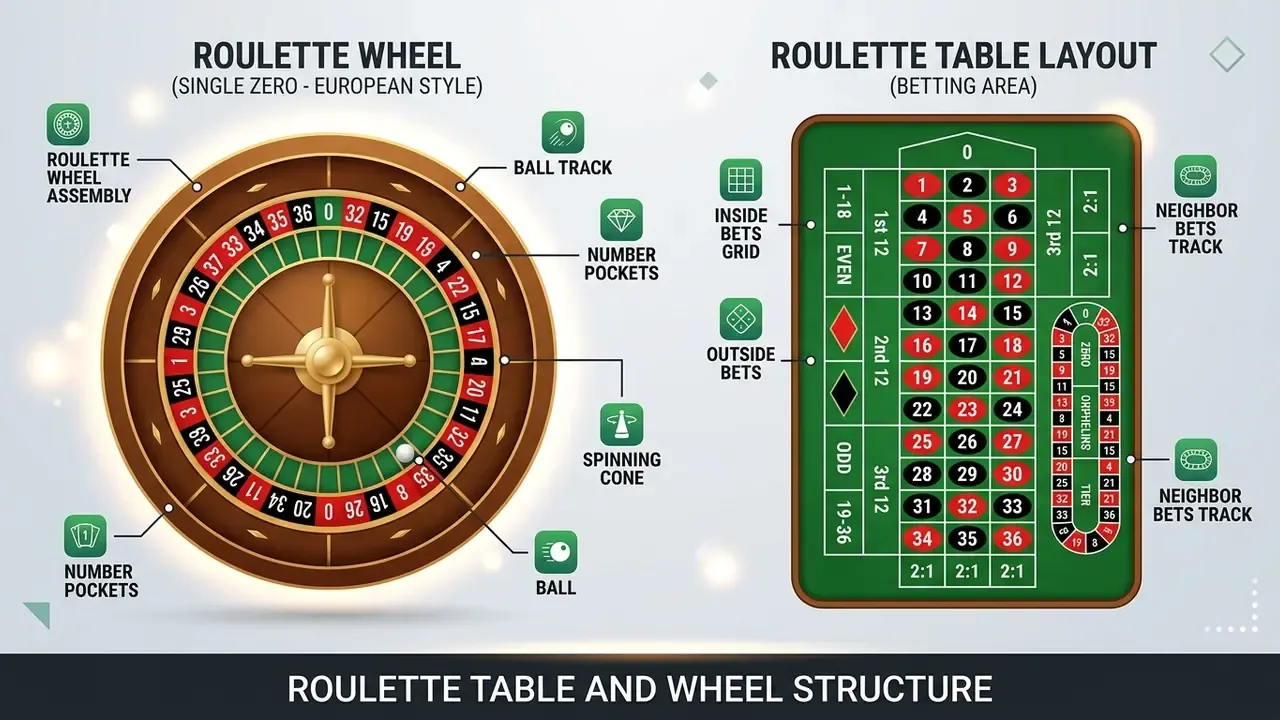
The physical or digital roulette wheel holds either 37 or 38 pockets depending on the variant you choose. The accompanying roulette table shows a betting layout where you place chips to select specific numbers or categories.
On the European wheel, numbers 1 through 36 alternate between red and black in a non-sequential pattern, with one single green zero pocket. The American wheel duplicates this layout but adds an extra 00 green pocket. That second green slot changes the math significantly, which we will cover later.
Your bets land on the roulette table grid. This surface features a central 1-36 number structure arranged in three columns and twelve rows. Sections for outside bets like odd or even flank the central grid. Casino software reproduces this exact table geometry, so your digital experience mirrors what you would see in a physical casino.

How a round plays out from bet to spin
Every active round of playing roulette follows a predictable routine from open bets to final payouts. The dealer leads the process and announces each stage. Here is the step-by-step sequence:
- Place your bets. Choose your chip value and put chips on the layout during the open betting window.
- Betting closes. The croupier announces "No more bets," locking all active wagers in place.
- Spin and release. The dealer spins the roulette wheel and rolls the ball along the rim in the opposite direction.
- Ball settles. The round ends when the ball drops into one final numbered pocket.
- Payouts. Winning bets are paid according to the fixed odds table; the house sweeps all losing chips.
That is the entire cycle. No mid-game decisions, no skill-based interventions. Once betting closes, the outcome is purely random.


Roulette rules for beginners
Universal roulette rules require you to pick a risk outcome, arrange your chips on the layout, and wait for the natural spin result. You have no mid-game decisions to make once betting ends. That simplicity is part of the appeal, but it also means the house edge is baked into every single wager.
The objective of roulette and the order of play
The primary objective of playing roulette is guessing the specific number, colour, or section where the ball eventually stops. You place your chips first, and the spin comes second.
Here is the honest truth: you do not "beat" the casino. You bet on mathematical probabilities, and those probabilities always favour the operator. As standard probability mathematics explains (referenced widely by WizardOfOdds), you buy chips with an assigned value, place them on the table layout, and wait. Once the ball drops, the dealer matches the pocket with the board. Because payouts are calibrated to 36 numbers instead of the actual 37 or 38 on the wheel, every single option carries a mathematical advantage for the house.

"Behavioural analysis shows that over 40% of roulette players ignore this structure and aggressively chase losses, increasing bets after negative outcomes." - Keith Burtis, "How Players React to Losses in Roulette" (2025).
Treat your session strictly as timed entertainment. Not a side hustle. Not an investment.
Key roulette terms for beginners
You only need a few core definitions before your first game. Knowing your terms prevents expensive mistakes at the virtual felt.
| Term | Definition |
|---|---|
| Spin | One full round of wheel motion and ball release |
| Chips | Tokens representing your active monetary value during the session |
| Straight up | A direct bet on one exact number (pays 35:1) |
| Split | A bet covering two directly adjacent numbers (pays 17:1) |
| Croupier | The human dealer who controls the game flow |
| Bankroll | The absolute total INR budget you allocate before logging in |
| House edge | The mathematical advantage built into every bet for the casino |
| RTP | Return to Player, the percentage of wagered money a game pays back over time |
Establish your bankroll limit before placing a single chip. This is not optional advice; it is the foundation of responsible play.
Roulette bets and payouts explained
You can divide all roulette bets into two main categories: inside bets and outside bets. Inside options carry the highest financial variance, while outside bets offer smaller payouts with higher win frequencies. The choice between them depends entirely on your comfort with risk.
Inside bets on the roulette table
Inside bets involve placing chips specifically on the numbered grid inside the layout. These wagers carry the lowest probability of success but the highest potential payouts.
A straight bet targets one single square and triggers a 35:1 payout. A split connects two numbers for a 17:1 return. A street bet covers three horizontal numbers offering 11:1 odds. A corner places chips at the intersection of four squares paying 8:1. A double street spans six numbers with a 5:1 reward. Standard probability mathematics confirms that these all share a 2.70% house edge on a single-zero layout. Worth noting: high-variance selections create long losing streaks, which means they carry significant bankroll risk even when the house edge is identical to outside bets.

Outside bets and simpler betting options
Outside bets target broad categorical properties like red, black, odd, even, low, or high. These provide the most stable choices for pacing your bankroll across a longer session.
An outside choice like red or black pays 1:1. These options cover 18 winning numbers out of 37 on a European setup, bringing your rough win probability to 48.65%. Because the zero acts as a loss for these colours, the casino edge remains exactly 2.70%. Dozens and columns cover groups of 12 and pay 2:1. Outside betting lowers the session volatility significantly. You win more often, but you still face negative long-term expected returns. No bet type escapes the math.
[TABLE: Comparison of roulette bet types] Purpose: Answers the intent of comparing bets and improves chances for a featured snippet on bet and payout queries.
Roulette bets: placement, risk, payouts and examples on a European wheel

| Bet type | Placement on roulette table | Numbers covered | Example numbers | Approximate risk level | Standard payout |
|---|---|---|---|---|---|
| Straight-up (Inside) | Directly on a single number square | 1 | e.g., 17 | Very high variance | 35:1 |
| Split (Inside) | On the border connecting two numbers | 2 | e.g., 17/20 | High variance | 17:1 |
| Street (Inside) | Outer border of a three-number row | 3 | e.g., 1, 2, 3 | Moderate-high variance | 11:1 |
| Corner (Inside) | Intersection of four number squares | 4 | e.g., 25/26/28/29 | Moderate variance | 8:1 |
| Six Line (Inside) | Intersection of two adjacent rows | 6 | e.g., 1-6 | Moderate variance | 5:1 |
| Red / Black (Outside) | Inside the red or black marked box | 18 | All red: 1, 3, 5, 7, 9, 12, 14, 16, 18, 19, 21, 23, 25, 27, 30, 32, 34, 36 | Lower volatility | 1:1 |
| Odd / Even (Outside) | Inside the odd or even marked box | 18 | All odd: 1, 3, 5 … 35 | Lower volatility | 1:1 |
| Dozen (Outside) | Designated 12-number group block | 12 | 1st 12: 1-12 | Moderate-low volatility | 2:1 |
| Column (Outside) | Bottom of one of three vertical columns | 12 | 1st column: 1, 4, 7, 10 … 34 | Moderate-low volatility | 2:1 |
The key takeaway: both inside and outside standard bets share the exact same 2.70% house edge on single-zero games. Choose your bet based strictly on your comfort with volatility, not on any belief that one type is "luckier" than another.
European, American and French roulette differences
The three major roulette variations differ heavily by wheel design and house mathematics. Always check the wheel type before committing funds. This single detail affects your expected losses more than almost any other factor.
European roulette vs American roulette
European roulette uses a single zero holding a 2.70% house edge, while American roulette adds a double zero raising the edge to 5.26%. That nearly doubles the casino's advantage against you.
The second green pocket on the American table cuts down your win probability while keeping the top payout locked at 35:1. The mathematical explanation is straightforward: on a European wheel the expected loss per unit bet is 1/37, roughly 2.70%. On an American wheel it is 2/38, roughly 5.26%. The extra 00 pocket reduces your win probability without adjusting payouts upward. You get worse odds for the same potential reward.

"Over 2,000 wagers the European format yields an expected bankroll loss of roughly €54, while the American format produces an expected loss of roughly €105, nearly double." - AncientGames, "American vs European Roulette: The House Edge Explained."
Single-zero games should be your default filter when choosing an online casino in India. If a platform only offers American roulette, that is worth noting before you deposit.
When French roulette may be the better choice
French roulette becomes the superior choice if you actively prefer even-money outside betting. Special French rules reduce the overall casino advantage to 1.35% on those wagers.
This format uses a standard European single-zero setup. However, it applies the La Partage or En Prison regulations when the zero pocket hits. If you bet on black and a green zero appears, La Partage refunds exactly half your wager. En Prison "imprisons" the bet for the next spin: if it wins, the original stake is returned; if it loses, the bet is forfeited entirely. This slashes the effective house edge in half for even-money positions.

"French roulette with La Partage achieves an optimal 98.65% return-to-player rate on even-money bets, the best among standard roulette variants." - Roulette.team, "Roulette Variants Compared: European, American, French."
One important caveat: you only receive this advantage on 1:1 bets, not on straight inside options. If you prefer inside bets, the French format offers no additional benefit over standard European roulette.
Fact Check Myth: All variants of roulette are equally fair. Fact: This is mathematically false. European and French versions supply better payout probability than American versions. The extra 00 slot roughly doubles expected losses without offering higher payouts. French roulette with La Partage cuts the house edge to 1.35% on even-money bets. Choosing the right variant is one of the few genuinely meaningful decisions a roulette player can make.
Modern online roulette variations
Beyond the three classic formats, online casinos now host several modern variants that attract significant player interest. Understanding their mechanics helps you make informed choices rather than getting swept up by flashy presentation.
Lightning Roulette
Lightning Roulette, developed by Evolution Gaming, follows standard European roulette rules but adds a random multiplier element. Before each spin, between one and five numbers are designated as "Lucky Numbers." These lucky numbers receive multiplied payouts of up to 500x, meaning a winning straight-up bet on a lucky number could return far more than the standard 35:1.
Here is the catch, though. To compensate for those occasional big multipliers, the base straight-up payout is reduced to 29:1 for non-lucky numbers. The overall RTP remains competitive with standard European roulette, but the variance increases dramatically. You might go through many more losing spins before hitting a meaningful win. That increased volatility is something to factor into your bankroll planning.

Double Ball Roulette
Double Ball Roulette uses two balls per spin instead of one, launched simultaneously by compressed air. This doubles your chances of hitting a chosen number on any given spin but adjusts payouts accordingly: a winning straight-up bet pays 17:1 instead of 35:1. If both balls land on your chosen number, the payout can reach 1,200:1. Outside bets like red/black pay 3:1 when both balls land on the selected colour.
The dual-ball mechanic creates a genuinely different feel from standard roulette. Rounds feel more eventful. But the adjusted payouts ensure the house edge remains intact.
Mini Roulette
Mini Roulette shrinks the wheel to just 13 pockets (numbers 0-12). The smaller wheel changes probabilities and payouts entirely. If the ball lands on zero, half of all bets are returned. This variant suits players who prefer faster rounds and a simpler betting grid, though the house edge can actually be higher than standard European roulette depending on the specific rule set. Always check the RTP before assuming a "mini" version is friendlier to your bankroll.
These modern variations are widely available at online casinos serving Indian players and can typically be tested in demo mode before committing real money.

Roulette online, live casino and live dealer formats
Digital roulette arrives in two distinct forms: algorithm-based simulation and live studio streaming. The distinction sits firmly in pacing, social dynamics, and the physical components involved.
How live dealer roulette differs from standard online roulette
Standard online roulette relies entirely on computer software algorithms (RNG, or Random Number Generator) to determine results. Live dealer roulette broadcasts a real human spinning a physical wheel from a dedicated studio. Same game, very different experience.
An RNG software game creates instant outcomes without physical friction. You control the pace completely. Live dealer roulette strictly matches the timeline of a physical casino. Research on social facilitation in gambling environments shows that the presence of other players, even online, alters betting behaviour:
"Participants who played roulette online alongside another player wagered the most chips per bet and selected the riskiest options." - GREO, Social Facilitation Experiment in Online and Offline Roulette.
That finding matters. The online medium combined with a human element reliably pushes players toward larger stake sizes. Digital anonymity coupled with live chat raises the likelihood of impulsive deposit chasing. If you play live dealer roulette, be especially vigilant about your pre-set limits.
What to expect from a roulette live casino table
A roulette live casino table supplies a real-time studio broadcast equipped with a fully interactive betting interface. You interact with a human croupier and observe digital overlays showing recent results and statistics.
The user interface commonly supports multi-camera viewing, active real-time chat, and deep statistical tracking boards. Leading providers like Evolution Gaming and Pragmatic Play typically enforce a strict timer countdown that manages the betting window. You must finalise chip amounts quickly. The pace does not wait for hesitation, which can feel pressuring at first.
While the chat feature adds atmosphere, it never changes the 2.70% house edge. The social element is entertainment, not an advantage.

"In online eCasino data, roulette showed the lowest average losses overall, yet win-chasing, faster return to play after winning sessions, was particularly pronounced in roulette." - Zhang et al., "Between-Session Chasing of Losses and Wins in an Online eCasino" (2024).
A stable mobile connection is important in India to avoid mid-spin disconnections and skipped turns. Use Wi-Fi or a strong 4G/5G signal for live sessions. A dropped connection during a live round can mean a lost bet with no recourse.
Roulette demo and free play before real money
You should test fundamental gameplay through a roulette demo before spending INR. Free mode offers a risk-free platform for learning UI placement and getting comfortable with the betting timer. Most online casinos allow demo access without registration, though some Indian-facing platforms may require a free account.
What demo mode helps you learn
Demo play teaches you how to map chip positioning accurately and navigate betting timer limits. You explore software variants without jeopardising actual deposit funds. It is genuinely useful for understanding the interface before real money is involved.
Free play duplicates the live physics and game mechanics. However, a significant behavioural study warns that demo modes often skew psychological safety in ways players do not expect:
"Participants exposed to free-play sessions, especially those ending in profit, bet significantly more per spin and spent more credits when they later switched to real-money mode, compared to a control group (n=80)." - SAHMRI, "Practice Gambling Modes and Their Effects on Real-Play in Computer-Based Roulette."
Treat the demo solely as an interface lesson. Understand that frequent virtual wins will not automatically translate to real-money profit. The demo is for learning buttons and bet types, not for building confidence in a "winning system."
When to switch from demo to real money roulette
You switch to roulette real money mode only when you fully accept the mathematical edge and hold a firm budget limit. Never switch simply because you hit a winning streak while holding virtual chips. That is precisely the trap the research warns about.
Cross-sectional research on simulated gambling and real-money transitions confirms the link between prolonged free play and elevated risk behaviour:
"The majority of simulated gambling products, apart from free loot boxes, were associated with higher PGSI scores and lifetime gambling problems." - Russell et al., "Order of First-Play in Simulated versus Monetary Gambling" (2023).
If you feel frustrated responding to demo losses, pause completely. That emotional reaction is a signal worth paying attention to. Set clear Indian-friendly payment checks first. Examine standard withdrawal constraints, assess UPI transaction speeds, and prepare KYC documents before deciding the platform warrants your actual funds. Start with strict flat betting at minimum table levels.
Disclaimer: If you notice signs of problem gambling, such as chasing losses, exceeding time or money limits, or gambling to escape stress, seek help from a licensed counsellor or contact a problem-gambling helpline.

Roulette strategy, odds and house edge
Disclaimer: The information below is general in nature and does not replace professional advice. Gambling carries financial risk. Play responsibly and set strict deposit limits before launching any game.
Every valid roulette variation commands a built-in mathematical advantage for the operator. A roulette strategy dictates pacing but absolutely never overrides the fixed house edge. Let us be clear about that upfront.
What roulette strategy can and cannot do
A roulette strategy resizes wagers depending on sequence histories but cannot guarantee a final payout. Progression structures change your timeline risk without fixing the underlying probability.
The famed Martingale strategy demands you double your bet size after every negative spin. Sounds logical on paper. But if you lose six rounds straight, table limits bar further doubling, and your accumulated losses can be substantial.
"Progressive betting systems produce many small wins but also create a heavy tail of catastrophic losses during extended losing streaks." - ATCM, "Analysis of Progressive Casino Game Betting Systems" (2023).
Beyond Martingale, players frequently discuss several other systems. None of them alter the house edge:
- D'Alembert:Increase your bet by one unit after a loss, decrease by one unit after a win. Gentler than Martingale but still negative-expectation over time.
- Fibonacci:Follow the Fibonacci sequence (1, 1, 2, 3, 5, 8...) for bet sizing after losses; move two steps back after a win. Creates slower progression but identical long-run expected loss.
- Paroli (Reverse Martingale):Double your bet after a win instead of a loss, aiming to capitalise on short hot streaks. Caps losses at flat-bet level but does not change the house edge.
- Oscar's Grind:A positive progression system where you increase bets by one unit after a win and hold steady after a loss, targeting one-unit profit per cycle. Mathematically, the house edge still applies.

Strategy provides discipline to an erratic game. Think of it as an entertainment structure, not an income formula. Flat bet sizes ensure the most reliable exposure control for your bankroll.
Best bets for lower house edge thinking
The smartest mechanical choices sit on a French or European wheel betting outside wagers. You want the highest possible coverage matched with the lowest zero penalty.
Selecting single-zero tables removes the doubled hazard of the American wheel immediately. Keeping your bankroll focused on red, black, odd, or even limits aggressive variance swings. For example, a player placing 100 even-money bets of ₹100 each on a European table faces an expected loss of roughly ₹270. The same player on an American table faces roughly ₹526 in expected losses. That gap adds up quickly over a session.
"Triple-zero wheels create an even higher house edge; players are strongly advised to avoid such tables whenever single-zero options are available." - CasinoBeacon, "Roulette Odds & House Edge Guide."
The probability gaps heavily penalise impulsive choices. Use simple even-money positions to stretch your entertainment budget effectively.
Warning: Roulette is strictly a game of chance. Betting strategies modify volatility; they cannot remove the built-in house edge. Expect long-term losses mathematically. Define strict deposit limits prior to launching a game to ensure safer habits. If roulette stops feeling like entertainment, stop playing.
How to choose the best roulette casino or game
A careful player strictly selects platforms offering readable payout terms, active responsible gambling functions, and fair software validation. You must audit trust signals before sending your first deposit.
Choosing between demo, live dealer and real money play
You use a demo for testing, RNG games for pace control, and live dealer options for atmospheric observation. Every channel suits a different engagement goal.
Beginners should start on free play to decode European table navigation. Standard RNG algorithms fit casual users who want brief sessions with low stakes. Live real-money play suits individuals looking for steady traditional timing and human croupier communication. Each progression steps up the emotional pressure. The risk of chasing climbs substantially within live peer environments, as the research we cited earlier confirms.
What makes a roulette game worth trying
A quality roulette game guarantees clear rules, transparent technical mechanics, and immediate access to support parameters. Skip any application that hides its baseline RTP details. Use this checklist:
- Single-zero layout (European or French) confirming lower house edge.
- Displayed RTP, with reputable games showing their return-to-player percentage (e.g. 97.3% for European roulette).
- Licensed and audited status, with a valid licence number and independent RNG testing lab (e.g. eCOGRA, iTech Labs, GLI).
- Responsible gambling tools including deposit limits, session timers, and self-exclusion options.
- Smooth mobile experience, tested for navigation ease and live-feed stability on your device.
- Transparent bonus terms with clear wagering requirements, maximum bet limits during bonus play, and expiry dates.
- INR support and accessible payments via UPI, net banking, or wallet deposits/withdrawals without hidden commission fees.
A game proves worthy only if the environment respects your bankroll and enforces visible walk-away limitations.
[TABLE: Pros / Cons Matrix] Purpose: Helps the user choose a game format before moving to an offer.
Demo vs Live Dealer vs Real Money Roulette Comparison

| Game Format | Learning Value | Casino Atmosphere | Financial Risk |
|---|---|---|---|
| Demo Roulette | High: Excellent practice ground for chip placement and UI navigation | Low: Missing social interaction | Zero: Uses virtual tokens only |
| Live Dealer Roulette | Moderate: Strict pacing requires prior knowledge | High: Human croupier, multi-camera views, and real-time chat | High: Social facilitation increases bet sizes |
| Standard RNG Real Money | Moderate: Great for rapid system testing | Low: Private, solo environment | High: Fast spin cycling impacts budget rapidly |
Payments, withdrawals and KYC in India
Indian players face specific practical considerations when moving from demo to real-money roulette. Handling these correctly prevents blocked funds and frustrating delays. A few minutes of preparation here saves genuine headaches later.
Depositing in INR
Most international online casinos serving India accept UPI (Google Pay, PhonePe, Paytm), net banking via IMPS/NEFT, and popular e-wallets. Some platforms also support cryptocurrency (BTC, ETH, USDT) for faster cross-border settlement. Always check whether the casino processes deposits in INR directly or converts from USD/EUR, as currency conversion fees can add 2-4% to every transaction. That percentage might seem small, but it compounds across multiple deposits.
Withdrawal timelines and limits
Withdrawal processing times vary by platform: UPI and e-wallet cashouts often complete within 24-72 hours, while bank transfers may take 3-7 business days. Before your first deposit, review the casino's minimum and maximum withdrawal limits. Some operators cap weekly withdrawals at ₹50,000 to ₹2,00,000 depending on your VIP level. Knowing these limits upfront prevents the unpleasant surprise of winning a decent amount and then waiting weeks to access it.
KYC verification
Licensed platforms require Know Your Customer documents before processing your first withdrawal. Prepare these in advance:
- Government-issued photo ID (Aadhaar card, passport, or PAN card)
- Proof of address (utility bill or bank statement dated within 90 days)
- Payment method verification (screenshot of UPI-linked bank account or e-wallet)
Submitting documents early avoids delays when you request a cashout. Platforms that skip KYC entirely should raise a red flag. Reputable operators use it as a security measure, not an obstacle. If a site never asks for verification, ask yourself why.

Tax on winnings
Under Indian tax law, winnings from online gambling are taxed at 30% (plus applicable cess) under Section 115BBJ of the Income Tax Act. Platforms may deduct TDS (Tax Deducted at Source) automatically. Maintain records of deposits, withdrawals and net winnings for your annual tax filing. This is not optional; the tax obligation exists regardless of whether the platform reports it.
FAQ
Last updated: 2026. All mathematical figures reflect standard single-zero and double-zero roulette rules. Gambling involves financial risk. Never wager more than you can afford to lose.