Baccarat Online: Rules, Strategy, Demo and Real Money Play

Reviewed by Nisha Rao, Casino Analyst with 8+ years of experience in Indian iGaming and mathematical probability.

Last updated: July 2026

"The biggest mistake Indian casino users make is assuming a fast game means easy money. Over the last 8 years of analyzing table games, the core truth remains unchanged: player safety and understanding the exact terms of the bet must come before the first spin or hand." - Nisha Rao, Casino and Betting India

RTP

98.94%

Volatility

Low

Baccarat Online Rules, Strategy, Demo and

Online baccarat operates on strict mathematical principles, leaving no room for emotional betting or complex maneuvering. Before you deposit your INR through UPI or NetBanking, you need to understand the house edge, the drawing rules, and the mathematical reality behind your bets. In the Indian market, where instant payments can bridge the gap between registration and real money play in seconds, taking time to learn the rules is genuinely your primary defense line. A clear understanding of baccarat strategy will not guarantee profit. But it will help you manage your bankroll and grasp the exact risks involved.

Quick Summary:

  • Banker is the best bet with a house edge of approximately 1.06%, the lowest available.
  • Player is a solid alternative at roughly 1.24% house edge, no commission.
  • Tie is the worst bet with a house edge of approximately 14.36%. Avoid it.
  • No strategy beats the house edge. Systems only change variance, not expected value.
  • Always play demo first. Learn commission mechanics and round flow before risking real INR.
  • Casino bonuses often trap baccarat players. A 5% wagering contribution turns a ₹1,000 bonus into ₹600,000 of required turnover.
Online baccarat operates on strict mathematical

What Baccarat Is and How the Game Works

Baccarat is a card comparing game where your only real action is placing a wager on which of two hands, the player or the banker, will achieve a total point value closest to nine. The game is deterministic. Once bets are closed, the house deals the cards according to strict, unchangeable rules, and no further user intervention is required. This low barrier to entry makes baccarat highly popular in both standard online formats and live casino lobbies across India.

"57.8% of Macao casino patrons had played baccarat at least once in the preceding 12 months, with 15.1% of those classified as problem gamblers under DSM-IV criteria." - Macao Casino Patron Study (PubMed).

Here is the thing many newcomers miss: baccarat is a game that relies entirely on an established algorithm rather than in-game human skill. The baccarat table is structured to accommodate three core outcomes. Whether you play baccarat online or at a physical table, the core mechanics depend on predicting the outcome of the hand. Recognizing how the game works helps you avoid the illusion of control and centers your focus on bankroll management.

Goal of the Hand and Card Values

The singular goal of the hand is to reach a total value closest to nine using two or three cards. To calculate the target total, you apply specific card values: cards from 2 to 9 hold their face value, aces equal one, and all tens and face cards (Jack, Queen, King) equal zero.

Card counting is effectively useless here. The fixed drawing rules mean that the composition of the remaining shoe has virtually no practical impact on the probability of a Banker or Player win. As confirmed in historical analyses of baccarat rules (arXiv preprint, Bertrand's probability analysis), the game's modulo-10 logic and deterministic dealing matrix neutralize any counting advantage.

If the sum of the cards exceeds nine, you drop the first digit. For example, a hand consisting of a 7 and an 8 totals 15, but the baccarat hand value is exactly 5. A two-card total of eight or nine is called a "natural," which ends the round instantly. Understanding this helps you quickly read the table without needing the software to explain every move.

Goal of the Hand and Card

Player, Banker and Tie at the Baccarat Table

You have three core betting options at the table: player, banker, and tie. Betting on the player simply means you back the player's hand to win. Betting on the banker means backing the house's designated hand, which holds a slight mathematical advantage due to the drawing rules. The Banker wins approximately 45.86% of all rounds, the Player wins 44.62%, and a Tie occurs in 9.52% of cases. These figures are confirmed across formal probability computations (baccarat probability analysis, Section 5.1).

The tie is a highly speculative, high-risk wager where you predict both hands will finish with the identical total. Before the initial cards appear, you must finalize your bet placement at the table. Once the round launches, the system takes over completely.

Player, Banker and Tie at the
  • Player:The structural hand position matching the player wager. It pays 1:1 and operates on standard third-card draw rules without a commission attached.
  • Banker:The hand position representing the house side of the draw. Winning bets typically incur a 5% commission because the banker acts last, granting it a slight probability lead.
  • Tie:A wager predicting both final totals will be exactly the same. It generally pays 8:1 but carries a massive house advantage.
  • Hand:The set of two or three cards dealt to either the player or the banker position during one round.
  • Cards:The standard 52-card decks used in the shoe. Tens and face cards hold a zero value.
  • Commission:The standard 5% fee taken by the casino from winning banker bets to offset its mathematical edge.
  • House edge:The mathematical advantage the casino holds over the user on any given wager. It proves that the long-term expectation is always negative for the player.
  • Live dealer:A format using high-definition streams where a real human croupier deals physical cards in real time.
K9win heading-banner

Baccarat Rules: How a Round Is Played

Baccarat rules dictate that the player and banker sides receive two initial cards, and a third card is dealt automatically depending on the starting totals. The dealer executes all actions. You will never face a hit or stand decision. That alone makes this a game apart from blackjack or poker.

The dealing order always starts with the player hand. Betting before cards are shown is strictly enforced. The round settlement happens immediately after the drawing phase concludes, making online baccarat extremely fast-paced.

When the Player and Banker Draw a Third Card

The player draws a third card if the initial two-card total is between zero and five, and stands on a six or seven. The banker response logic is more complex and relies entirely on what the player hand draws.

The banker generally draws if its total is between zero and two. If the banker holds an initial three through six, drawing depends entirely on the value of the player's third card. The table below summarizes the banker's third-card matrix:

Banker TotalDraws When Player's Third Card IsStands When Player's Third Card Is
0-2Always draws-
30-7, 98
42-70, 1, 8, 9
54-70-3, 8, 9
66-70-5, 8, 9
7-Always stands

Why does this rule matter? Simple: acting second provides more information, which directly skews the win probability toward the banker hand. These fixed table rules mean external forces cannot manipulate the draw.

How Winnings, Losses and Commission Are Settled

A winning player bet returns an even 1:1 payout, while a winning banker bet pays 1:1 minus a standard 5% commission. Understanding this logic protects you from accounting surprises during real money play.

Tie bets generally pay out at 8:1. Losses settle immediately, and your staked funds vanish from the virtual felt. Some casinos offer no-commission options, which waive the 5% fee but reduce the banker payout to 0.5:1 if the banker wins with a specific number like six.

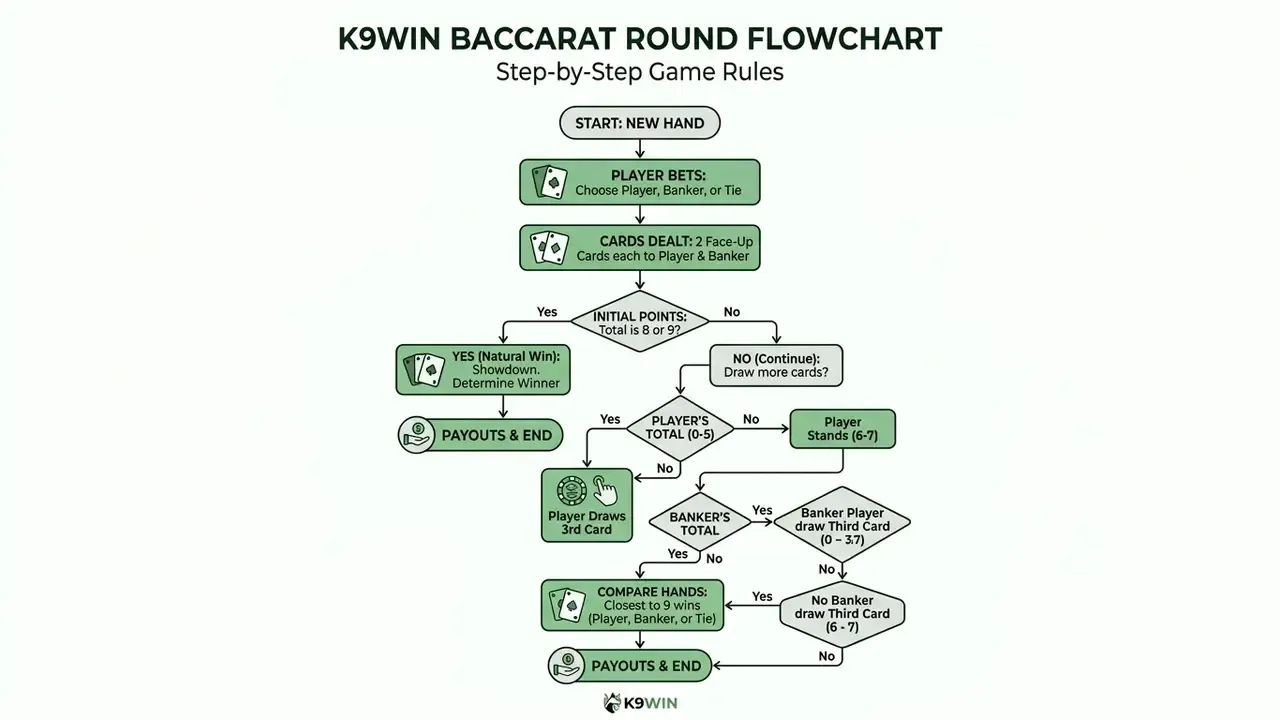
Baccarat rules and round flow
  1. Betting phase: Users place stakes on player, banker, or tie before the timer expires.
  2. Initial deal: The dealer administers two cards to the player and two cards to the banker.
  3. Natural check: If either side possesses an 8 or 9, the round terminates immediately.
  4. Third card evaluation: The dealer administers a third card to the player if their total is 0-5. The banker subsequently draws based on the strict matrix rules outlined above.
  5. Outcome declaration: The hand containing the total closest to nine wins.
  6. Payouts and collection: Winnings disburse to user balances; losing stakes clear the board.
1. Betting phase Users place stakes

How to Play Baccarat Online, Live Dealer and Demo

You can access baccarat in three distinct formats: demo practice modes, standard random number generator (RNG) tables, and live casino lobbies. Choosing the right format depends heavily on your comfort level with risk and your need for realism.

Baccarat online options range from minimal graphical interfaces to immersive studio setups. Your Indian internet connection speed, preferred device, and understanding of the game should all guide your choice. Let me walk through each format.

Baccarat Demo for Learning Without Real Money

Baccarat demo offers the exact mathematical rules of the real game but utilizes virtual chips. Practicing here holds immense value because it familiarizes you with the betting flow without real money exposure.

How to access demo mode in 3 steps:

  1. Visit a reputable online casino platform and navigate to the Table Games section.
  2. Look for any baccarat title with a "Play for Fun" or "Demo" button. Registration is usually not required.
  3. Place virtual bets for at least 50 rounds, focusing on the commission deductions and round flow before transitioning to real money.

Testing rules through demo play removes the pressure of dropping your INR balance while figuring out commission deductions. A common pattern among new users is rushing into high-stakes live dealer rooms without grasping the 5% banker fee. I have seen this repeatedly in reader feedback. Routing yourself through demo mode for 50 flat-betting rounds before playing for cash helps build significantly better bankroll retention and reduces emotional tilt when transitioning to real-money games.

Baccarat Demo for Learning Without Real

Live Dealer Baccarat vs Standard Online Baccarat

Live dealer baccarat streams a human dealer managing physical cards, while standard online baccarat relies entirely on audited RNG software. The similarities lie in the payouts, odds, and table structure.

The differences center around four key factors:

  • Pace of play:RNG games allow you to dictate the speed, clearing rounds in seconds. Live baccarat forces you into a timed betting window alongside other players, typically 20-30 seconds per round.
  • Social interaction:Live baccarat includes chat menus and dealer interaction, creating a realistic casino atmosphere absent from RNG play.
  • Visual authenticity:A live studio with physical cards and a real table creates immersion that purely digital interfaces cannot match.
  • Speed control:Standard RNG games fit users who want pure mechanics without waiting for others. You can also explore different live dealer casino formats to compare lobby styles.
Live Dealer Baccarat vs Standard Online

"According to the Pennsylvania Online Gambling Report 2024, 19.8% of adults had engaged in online gambling within the preceding 12 months." - Pennsylvania Online Gambling Report, 2024.

Worth noting: the format you choose does not change the math. The house edge on a Banker bet is the same whether a human dealer or an algorithm handles the cards. What changes is your pace of play, and that directly affects how quickly your bankroll moves.

Baccarat Bets Explained: Which Options Are Best

The best baccarat bet is mathematically and reliably the banker side due to its lowest overall expected loss. You have three primary wagers: the player bet, the banker bet, and the tie bet.

Deciding where to place your money comes down to simple risk and return logic rather than intuition. Evidence-based studies consistently highlight the structural advantage the house maintains across all options. Your approach should revolve around limiting that house edge exposure.

Why the Banker Bet Is Usually the Best Baccarat Choice

The banker bet is statistically your best baccarat choice, carrying the lowest long-term house edge at roughly 1.06%. While the 5% commission trade-off feels limiting, it balances the fact that the banker hand wins approximately 45.86% of all rounds, pulling slightly ahead of the player's 44.62%.

Because the banker acts last, it possesses a slight advantage in the third-card drawing matrix. This consistency explains why many flat-betting strategies start strictly by backing the banker. You sacrifice a fraction of the payout to secure a fundamentally lower-volatility position. Think of it this way: you are paying a small fee for a better probability.

Why the Banker Bet Is Usually

When Player and Tie Bets Make Sense

The player bet makes sense when you want a simpler alternative that avoids commission calculations while retaining a competitive 1.24% house edge. The tie bet, despite offering staggering payouts, serves as a high-risk speculative option.

Experienced players heavily discount the tie bet. According to formal probability calculations for standard 8-deck baccarat (baccarat mathematical analysis, Section 5.1), a standard tie operates with a house edge of approximately 14.36%. The tie outcome occurs roughly 9.52% of the time, making it a fast track to bankroll depletion for anyone relying on it consistently.

Comparison of primary wager options in baccarat

When Player and Tie Bets Make
Bet TypeHouse EdgeWin ProbabilityRisk LevelCommissionStrategic Value
Banker~1.06%45.86%LowYes (5%)Best foundational wager for long-term consistency.
Player~1.24%44.62%Low-MediumNoSimple 1:1 value; excellent for tracking exact bankroll totals.
Tie~14.36%9.52%Extremely HighNoSpeculative; generally excluded from safe gambling strategies.

The brief summary remains clear. Banker provides math-backed stability. Player delivers clean, even-money payouts. Tie introduces severe volatility and guarantees harsh long-term losses.

Baccarat Strategy: Practical Systems and What to Expect

No baccarat strategy will overcome the house edge. However, a structured betting system can enforce discipline and define your stop-loss points. Winning expectations must align with reality: casino metrics universally verify a negative long-term yield for all users.

Using a strategy helps you maintain control. Baccarat strategy systems include progressive betting methods and flat wagers. They organize how much you risk over time rather than guaranteeing any profit. Treat strategies as structural tools, completely divorcing them from any "unbeatable" marketing hype you might encounter online.

Flat Betting, Martingale, Paroli and Fibonacci

Flat betting is the baseline approach where you fix your risk to one identical unit per hand, minimizing volatility. It is the safest method for beginners because it does not escalate exposure after losses. Sequence-based systems, on the other hand, attempt to engineer results through fluctuating stakes.

The Martingale system forces a negative progression: you double your stake immediately after every loss. Simulations from the UNLV Gaming Institute show that Martingale raises the probability of small short-term profits but dramatically increases the risk of catastrophic losses during extended losing sequences (UNLV, R-based Martingale study).

Here is how Martingale works in a 3-hand sequence:

Flat Betting, Martingale, Paroli and Fibonacci
HandBetOutcomeRunning Profit
1$10Loss-$10
2$20Loss-$30
3$40Win+$10

Looks neat on paper. But imagine five consecutive losses. Your sixth bet would need to be $320 just to recover $10 in net profit. Table limits and bankroll reality usually intervene before the system "works."

Paroli operates as a positive progression, commanding you to increase stakes following a win to capitalize on streaks. Here is how Paroli works:

HandBetOutcomeRunning Profit
1$5Loss-$5
2$5Win$0
3$10Win+$10

The Paroli system offers a relatively low risk of large losses, making it a solid option for newcomers or risk-averse players. Wins remain small unless you encounter a sustained hot streak, though.

The Fibonacci structure relies on mathematical sequence sums (1, 1, 2, 3, 5, 8, 13, 21...) to gradually adjust bet sizes. After a loss you advance one step in the sequence; after a win you step back two positions.

HandBet (Units)OutcomeRunning Profit
11 ($5)Loss-$5
21 ($5)Loss-$10
32 ($10)Loss-$20
43 ($15)Win-$5
51 ($5)Win$0

Mathematical analyses of progressive mechanics confirm that systems like Paroli and Martingale reshape the distribution of outcomes but do not alter the negative mathematical expectation. The expected loss per unit wagered remains constant regardless of bet-sizing pattern (UNLV Gaming Institute, analysis of Paroli and Let-It-Ride systems).

Can You Win at Baccarat Consistently

You cannot win at baccarat consistently over an extended timeline, because the house edge guarantees an unyielding mathematical tax on your aggregate turnover. Your realistic expectations for short sessions might include minor spikes of profit, but long-term outcomes always favor the operator.

"Evidence-based safe gambling guidelines explicitly warn that the belief that systems will ensure success in gambling is a cognitive risk factor for harm." - Evidence-Based Safe Gambling Guidelines Study, 2019.

Variance creates the temporary illusion of skill. In reality, baccarat is subfair. Every chip you commit faces a negative expectation. Stop treating losses as precursors to an inevitable win.

Fact Check: Baccarat Strategy Limits

  • Myth: "A specific baccarat strategy +4 sequence guarantees a win at baccarat." Reality: No system changes the math. Studies clearly indicate strategies merely shift the timeline of the variance.
  • Myth: "Card counting gives you an edge." Reality: You make zero decisions regarding drawing cards. Online RNG baccarat shuffles the virtual shoe after every round, making the count mathematically useless. Even in live shoe games, the fixed dealing matrix means shoe composition has negligible impact on Player vs. Banker probabilities.
  • Myth: "The tie bet is a smart long-term accumulation play." Reality: Sitting at a 14.36% house advantage makes it the fastest way to decimate a session budget.

How to Play Baccarat for Real Money With Less Risk

Disclaimer: The information in this section is general in nature and does not replace professional financial or legal advice. Online gambling involves inherent financial risk. Ensure that online casino play is permitted in your specific Indian state before depositing real funds. Treat casino access purely as paid entertainment, never as an income source.

Playing baccarat real money sessions safely demands strict budgeting, realistic payment planning for India, and proper casino selection. With real capital at risk, you must evaluate operators based on transparency rather than flashy bonus banners.

Entering a real money lobby means accepting potential losses. Choosing a baccarat casino requires checking basic trust parameters. Furthermore, understanding your session limitations protects you from chasing deficits through fast UPI deposits. Bonuses and offers demand heavy scrutiny, as wagering requirements often drag out your exposure to the house edge.

Playing baccarat real money sessions safely

What to Check Before Joining a Baccarat Casino

Before initiating a deposit, verify the platform using this checklist:
  • Active international license:Look for regulators like MGA (Malta Gaming Authority) or Curacao eGaming. A license ensures the operator meets minimum standards for fair play and fund protection.
  • KYC verification:The casino should clearly outline identity verification procedures before allowing withdrawals. If this information is buried or absent, that is a red flag.
  • INR payment support:Confirm the platform natively supports NetBanking, UPI, or other Indian payment methods without hidden currency conversion fees. You can compare available online casinos for baccarat to find INR-native operators.
  • Mobile usability:The vast majority of Indian users engage via smartphones. Test the lobby interface before depositing.
  • Table game bonus terms:Often, casino bonuses exclude baccarat games entirely or only contribute 5% towards wagering requirements. This creates a devastating multiplier effect on your required turnover.
What to Check Before Joining a

"The Pennsylvania Online Gambling Report 2024 finds that 7.8-8.7% of adults could be classified as at-risk or problem gamblers." - Pennsylvania Online Gambling Report, 2024.

Red Flags for Spotting a Scam Casino:

  1. No verifiable license or regulator listed on the site.
  2. Withdrawal delays exceeding 7 days with no communication.
  3. Bonus terms that change retroactively or are buried in unclear language.
  4. No responsible gambling tools (deposit limits, self-exclusion).

The Bonus Trap: Why 5% Contribution Hurts Baccarat Players

The wagering contribution issue deserves special attention because it is one of the most damaging traps for card game players. Here is a concrete example:

ParameterSlots (100% Contribution)Baccarat (5% Contribution)
Bonus amount₹1,000₹1,000
Wagering requirementx30x30
Required turnover₹30,000₹600,000

At a 1.06% house edge on Banker bets, your expected loss while clearing a ₹600,000 wagering requirement would be approximately ₹6,360, far exceeding the ₹1,000 bonus. Avoid taking bonuses if you plan to play baccarat exclusively. The math simply does not work in your favor.

Bankroll and Session Control Before You Place Bets

Establishing rigorous bankroll planning is mandatory before you launch the application. Bet sizing should never exceed 1% or 2% of your total session budget.

"Nine evidence-based safe gambling practices include: setting a fixed budget, refusing to gamble on credit, and avoiding play while upset or intoxicated." - Evidence-Based Safe Gambling Guidelines Study, 2019.

Avoiding chasing losses marks the turning point between entertainment and gambling harm. New users often use immediate digital payments to reload balances mid-frustration. I have seen this pattern enough times to call it the single biggest risk for Indian baccarat players using UPI. Implementing strict session controls is essential:

  • Set a fixed time limit of 30 minutes per session.
  • Use built-in casino tools: Most licensed operators offer deposit limits, reality checks (pop-up timers), and session duration timers that you can configure in account settings.
  • Mandatory stop-loss: Decide your maximum acceptable loss before opening the app. When you hit it, close the application immediately.
  • Never chase losses through fast UPI reloads mid-frustration.

Adhering to these stop limits effectively eliminates emotional betting and preserves structured strategy for real play. Making strategy sustainable requires stopping while you still hold control.

Avoiding chasing losses marks the turning

Risk Note / Disclaimer: Playing baccarat real money games involves absolute financial risk. Any capital deployed is subject to loss. No strategies alter the fact that the casino holds a permanent mathematical edge. Additionally, online gambling legality varies drastically across Indian states. Always verify your local state regulations before utilizing any real money platform. Treat casino access purely as paid entertainment.

Online Gambling Legality in India: What You Need to Know

The legal landscape for online gambling in India is complex and varies by state. There is no single federal law that explicitly bans or permits online casino play. The Public Gambling Act of 1867 predates the internet and primarily addresses physical gambling houses. In practice:

  • States like Goa and Sikkim have specific frameworks permitting certain forms of gambling.
  • States like Telangana, Andhra Pradesh, and Tamil Nadu have enacted stricter legislation that may cover online gambling.
  • Offshore casinos operating under international licenses (MGA, Curacao) are accessible from most Indian states, but the legal gray area means players should understand their local regulations before depositing.
  • Always check your specific state's current gambling laws and consult a legal professional if uncertain.

This is not legal advice. It is a general overview to help you ask the right questions before committing real money.

Online Gambling Legality in India What

Best Baccarat Game Formats and Common Variants

The best baccarat format depends heavily on your bankroll, local bandwidth for live streams, and preference for speed. The industry features multiple baccarat games catering to different playing styles.

Differences in table feel, pacing, and limits mean you can locate a variant well-suited to your intent without much difficulty. Popular online options focus on rapid dealing, while immersive lobby formats concentrate heavily on luxurious interactive setups.

Mini Baccarat, Live Baccarat and Classic Table Play

Mini baccarat delivers a compact table format utilizing a single dealer, typically offering low minimum bets (often $5-$10 equivalent) ideal for beginners managing modest budgets. A single dealer handles all cards, and the table seats fewer players. RNG mini baccarat can clear hands in under three seconds, making it the fastest variant available.

Classic table play (Punto Banco) provides the traditional casino feel with a larger virtual shoe and slightly slower physical dealing animations. Punto Banco is the standard North American variant where all drawing rules are completely fixed and automatic. The player makes no decisions after the initial bet. This is the most common version found in both online and live lobbies worldwide.

Live baccarat sits at the peak of the hierarchy. A dealer-led live play session runs synchronously with hundreds of global users simultaneously. Session speed dictates the experience: a live dealer variant takes up to thirty seconds per hand, forcing you to slow your wager frequency and naturally reducing your hourly exposure to the house edge. For many Indian players with stable 4G or Wi-Fi, this format offers the most engaging experience.

Mini Baccarat, Live Baccarat and Classic

"According to the Nevada Gaming Control Board 2023 data, baccarat accounts for 7.4% of the state's total table game win." - Nevada Gaming Control Board Information Sheet, 2023.

Baccarat Variants: Chemin de Fer, Baccarat Banque and Speed Baccarat

Beyond the core formats, several variants offer distinct gameplay experiences:

Chemin de Fer is the traditional French variant popularized in James Bond novels. Unlike Punto Banco, players can choose whether to draw a third card, and players take turns acting as the banker. This introduces a genuine element of decision-making skill that is absent from standard online baccarat. Chemin de Fer is rarely found in online lobbies but occasionally appears in European live casinos.

Baccarat Banque is a European variant where one player serves as banker for the entire session. It typically uses three decks instead of eight and allows for more strategic play by the banker position. It is rarely offered in modern online casinos, so you are unlikely to encounter it during regular play.

Speed Baccarat is a live-casino variant with shortened round times, typically 10-15 seconds versus the standard 25-30 seconds. The rules are identical to Punto Banco, but the faster pace means significantly more hands per hour and correspondingly faster bankroll movement. If you are not careful, Speed Baccarat can burn through a session budget remarkably quickly.

Lightning Baccarat adds random multipliers to selected card positions each round, creating the possibility of enhanced payouts. The base rules follow Punto Banco, but a portion of each bet funds the multiplier pool, effectively increasing the house edge compared to standard baccarat. The excitement of potential multipliers comes at a real mathematical cost.


Baccarat Variants Chemin de Fer, Baccarat

Baccarat FAQ Before You Start Playing

Understanding the foundational elements before navigating into demo mode prevents early friction and clarifies common misconceptions. Safety, rule complexity, and mobile usability regularly dominate newcomer inquiries.

Below are concise practical clarifications designed to finalize your base knowledge of baccarat. We address fairness protocols, comparison with alternative tabletop offerings, and why baccarat generally fits novice exploration effectively.

Is Baccarat Online Fair and Safe to Play?

Baccarat online operates fairly when accessed via reputable operators deploying certified RNG software. True safety separates the game format from operator trust.

Any licensed online casino must undergo audits by independent laboratories like eCOGRA or iTech Labs. These tests verify the code runs identically to natural probabilities. The mechanism is inherently fair. Your safety depends entirely on selecting a platform with an untarnished withdrawal history and proactive responsible gambling tools, including deposit limits, session timers, and self-exclusion options.

Is Baccarat a Better Choice Than Other Casino Games for Beginners?

Baccarat forms an inherently better choice for beginners because the game requires zero post-bet decision making. The simplicity of rules neutralizes the steep learning curve found in alternative genres.

Unlike blackjack, where mathematics force you to memorize complicated hit, stand, and split charts, baccarat resolves itself independently through the fixed dealer matrix. Unlike poker, where players must decide whether to fold, call, or raise across multiple betting rounds, baccarat requires a single pre-hand wager. The limited bet menu forces a clear selection. This absence of complex decision-trees makes it substantially easier to learn, allowing novices to focus entirely on managing their balance securely.

Is Baccarat a Better Choice Than

"A 2024 Victoria gambling participation study found that casino table games are consistently associated with elevated risk of problem gambling, alongside electronic gaming machines and sports betting." - Victoria Gambling Participation Study, 2024.

This balanced perspective matters: while baccarat's simplicity makes it accessible, the speed of play and real-money involvement still carry genuine risk. Beginners should always start in demo mode and set strict session limits before wagering INR.

What Is the Difference Between Punto Banco and Chemin de Fer?

Punto Banco is the standard variant where all drawing rules are fixed and automatic. The casino banks every hand. This is a pure game of chance.

Chemin de Fer allows players to make third-card decisions and take turns being the banker. It involves skill in third-card choices and is more commonly found in European land-based casinos. If you want pure, decision-free online play, Punto Banco is your format.

Can Card Counting Work in Baccarat?

No. While traditional card counting in blackjack assigns +1 to low cards and -1 to high cards, the technique does not transfer to baccarat for two reasons:

  1. Online RNG baccarat shuffles the virtual shoe after every round, making any running count mathematically meaningless.
  2. Live shoe baccarat uses fixed drawing rules where the player makes no decisions. Even if you track every card, the rigid Banker/Player draw matrix means shoe composition produces negligible edge shifts, far below the commission cost.

Some counting systems for baccarat do exist (for example, assigning Ace/2/3 = +1, 4 = +2, 5/7/8 = -1, 10/J/Q/K = 0), but even under ideal conditions in a live 8-deck shoe, the theoretical advantage is so marginal that it is not practically exploitable. Save your mental energy for bankroll management instead.

Can Card Counting Work in Baccarat

What Is the Best Starting Strategy for a New Baccarat Player?

Start with flat betting on the Banker hand in demo mode. Place 50 consistent-size bets while observing the commission deductions and round flow. Once comfortable, transition to real money with a session budget and a maximum bet of 1-2% of that budget per hand. Do not use progressive systems (Martingale, Fibonacci) until you have completed at least 200 hands of flat betting and understand your personal risk tolerance.

Where to Start Right Now

  1. Open demo mode at a licensed casino and play 50 flat-bet rounds on Banker.
  2. Study the commission math: Confirm you understand the 5% deduction on winning Banker bets.
  3. Set your real-money session budget. Never more than you can afford to lose entirely.
  4. Configure your casino account tools: Deposit limits, session timers, and loss limits before your first real bet.
  5. Play your first real session: Stick to Banker, flat bets at 1% of bankroll, 30-minute maximum. Close the app when your session ends or your stop-loss triggers, whichever comes first.